Safety First
AI must not compromise patient safety. Where there is a conflict, safety takes precedence.

About this page: this section is provided to offer transparency to all stakeholders and proactively address enquiries regarding the technology.
Our work involves the care of people who are often vulnerable, the handling of sensitive personal and clinical data, and the exercise of professional clinical judgement under statute. Use of artificial intelligence is framed by this context and we look at risks in relation to that. See FAQs below for detailed information.
As such while also being committed to leveraging AI to improve and scale mental health services, our approach means patient safety, clinical judgement, and data security are not compromised. This human-led care is intelligently supported by technology.
Thrive and its founders have always had a compliance, governance and risk- based approach even though Thrive’s activities are not regulated. It’s in our DNA. We bring this to bear on AI as we do in everything.

Patient safety first.
Thrive distinguishes 3 tiers, determining the level of scrutiny, approval, and documentation required; and applies 5 principles which underpin our approach and ensure AI activities remain safe, lawful, and proportionate.
AI must not compromise patient safety. Where there is a conflict, safety takes precedence.
We are open about where and how AI is used, ensuring no obscuration of its involvement in our work.
Humans remain fully accountable for all decisions and outputs; AI cannot displace professional responsibility.
We actively work to prevent discriminatory outcomes, aligning with the UK’s Equality Act 2010.
Governance is scaled to match the level of risk associated with the task.
The landscape of AI tools available is constantly changing. “Frontier models” (LLMs) are the most advanced, largest-scale generative AI systems available, represented by market-leading families like OpenAI GPT, Anthropic Claude, and Google Gemini. Thrive uses them all.
However they can be expected to evolve at different rates, in different directions, applying different pricing and/or economic models, with different capabilities, varying risk profiles and vulnerabilities, and with potential political considerations dictating availability. Thrive will therefore continue to build flexibly, and use them in different ways and to differing degrees and above all cannot be irrevocably tied to one model or another.
Any emerging and relevant technologies' use will be guided by Thrive's foundational principles and tiers.
Having delivered best in class therapy outcomes in this space for some years, Thrive is able to leverage millions of data points in its new platform to optimise service delivery.
Clinical use of AI presents the greatest opportunity and the most significant risk. Consequently, we maintain a "human-in-the-loop" requirement:
AI-generated content (e.g., draft letters, formulations) must be reviewed by a qualified clinician who retains full professional responsibility.
No patient-identifiable data may be entered into non-approved tools.
Thrive combines the scalability of digital tools with the clinical depth of accredited therapists to address accessibility, friction and efficacy gaps in mental health care.
Fully automated solutions (e.g., chatbots) currently lack the therapeutic alliance crucial for impactful outcomes, while therapist-only solutions are costly and limited in reach.
For Therapy users, Thrive uses AI to make recommendations via the Therapist , and to monitor and improve therapy (therapy assistant), so there is a human review gate. We don’t plan on using AI directly to a user without a human gate.


There is polarisation in the market. Consumers are self-serving support by asking chatbots (see below) whilst the clinical system is shifting toward an intelligent mental health infrastructure utilising aggregated data to understand organizational stress, rather than simply offering a feature upgrade with each release of the tech.
This infrastructure will evolve across other areas of healthcare to provide a holistic approach with shared data.
Thrive believes its use of AI in a supportive rather than replacement role balances all aspects of the issue with the right type of risk management, and provides intelligent therapist matching that is more effective than other models.
In short Thrive has the DNA, Data and Development roadmap to Transform Therapy by personalising the user experience, enhancing the therapist experience, improving triage and assessment, and supporting therapists to deliver Measurement Based Care using Thrive's Therapy Optimisation technology.
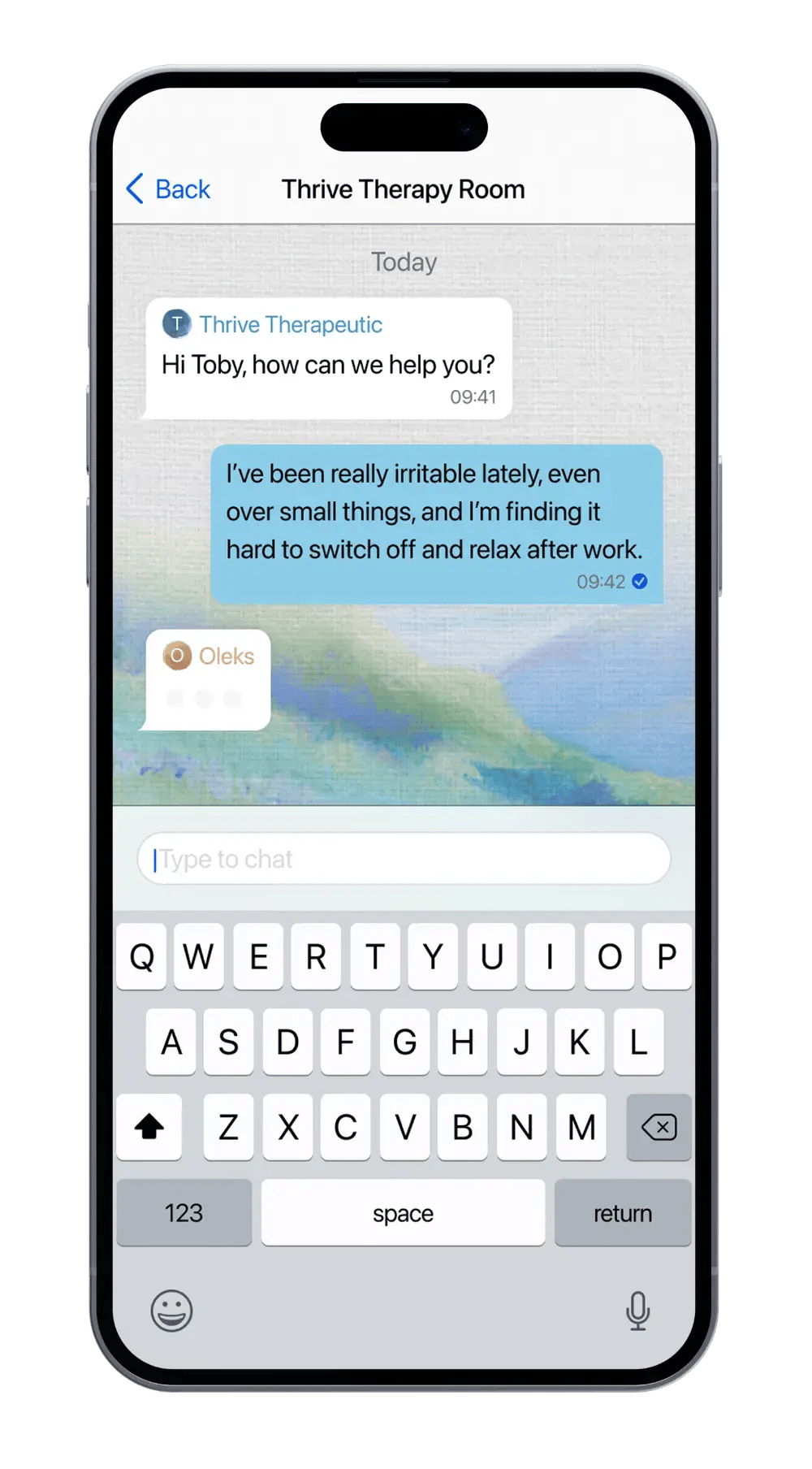
This AI use case is one of the most exciting but also most contentious areas in mental health support. In particular chatbots in protracted dialogue with service users. Thrive does not use chatbots in this way. In the words of our Co-Founder Dr Fonseca, “Generative AI has specific applications in our strategy that have nothing to do with chatbots.’ This is in part due to incompatible training, superficial helpfulness and regulatory risk.
GenAI training is currently fundamentally incompatible with the required therapeutic stance. Superficial Helpfulness: Models are trained to be helpful on an answer by answer basis, and will not engender the discomfort or challenge required to help individuals process trauma or pathology. Regulatory Risk: Already several regulators in the US have clamped down on this practice, enforcing strict limitations.

All tools and systems that generate, transform, summarise, or analyse content using artificial intelligence, including but not limited to large language models (e.g. ChatGPT, Claude, Gemini), image generators, transcription and dictation tools, coding assistants, and any AI features already embedded within Thrive (e.g. AI features in Google Workspace).
It covers AI whether it is the primary product (a standalone chatbot) or an embedded feature within another product (autocomplete suggestions, smart replies, AI-generated summaries). If a tool uses AI to process information related to Thrive’s work, it’s covered by Thrive’s AI policy.
In part, but potentially with more wide ranging consequences and risks associated with its use. Thrive does not attempt to define the precise technical boundaries of “AI” versus conventional software. The test is functional: if a tool generates, predicts, classifies, or synthesises content in a way that could influence decisions, communications, or records, it falls within the scope of Thrive's AI policy.
We know that because access to traditional care is limited, while the barrier to opening a chatbot is near zero, millions of people are using tools like ChatGPT to support a wide range of needs, but they were not designed or validated for mental health support.
There are tens of thousands of paid for chatbot sessions each day with various claims and satisfaction scores. However the risk of using chatbots in this way is significant, and without peer-reviewed research, none of these numbers mean anything to the people who need to trust them: health systems, regulators, and above all users.
In summer 2026 research commissioned by mental health charity Mind found people are using AI chatbots to support their mental health and wellbeing instead of professional clinical care and more formal support like talking therapies. The charity’s safeguarding team had reported an increasing emerging trend about AI harm and mental health.
We don’t know the long-term effects of using AI. And we also don’t know who’s most at risk of harm from AI.
To quote MIND’s website:
there is evidence that using AI can have negative impacts on our mental health, wellbeing and safety.
Some impacts might be more likely if we have experience of certain mental health symptoms, like psychosis. Or if we don’t have enough other support. This can be especially hard if we feel we have no choice but to use AI
Some evidence shows that anyone who uses AI for any reason could be negatively affected by it. And that it can impact our wellbeing even if we don’t use it. Or if we don’t have a mental health problem.
Using AI might make some mental health problems worse, including:
- Obsessive compulsive disorder (OCD)
- Psychosis
- Mania and hypomania
- Depression
- Health anxiety
- Eating problems. AI might give you harmful information about diet and food.
AI can impact other mental health problems as well. You might find AI helps your mental health in some ways, but harms it in other ways.
Compared to what? The scarce and expensive resource in mental healthcare is qualified clinical time. The tasks we use LLMs for, such as supporting the therapist, improving triage and assessment, and monitoring the quality of therapy, cost pennies per task when set against the professional time they make more productive. And that cost is falling at an extraordinary rate: LLM inference follows the same experience-curve economics (Wright's Law) as every computing technology before it, with independent measurement showing costs falling by orders of magnitude in under two years. Used our way, AI is one of the cheapest inputs in the service, not one of the dearest.
Our architecture also means we are never a price-taker to a single vendor. Every feature routes through Thrive's own AI integration layer, with token budgets and usage recording applied centrally, so each task runs on whichever provider offers the best price for the capability required. Switching provider is a configuration exercise, not a rewrite. And because our use of AI is human-gated rather than an open-ended consumer chat service, volumes are bounded and predictable by design.
Thrive retains the ability and the option to apply a small custom LLM (AI Model) to make the contextual decision from user input, ie. to take some freeform text, and determine from it the patient's presentation. At present there are no obvious advantages of prioritising this solution.
Thrive has minimised dependency on any single generative-AI supplier by introducing a Thrive-owned AI integration layer. Product features submit a common message-based request to this layer; provider adapters translate it into the APIs used by OpenAI, Anthropic or Google Gemini and normalise their responses. Provider credentials, organisational enablement, data-egress policy, token budgets, usage recording and audit controls are applied centrally. Provider and model choices are held in organisational configuration rather than embedded in feature logic.
Core text-generation workflows use the common subset of provider capabilities and validate structured results against Anchor-owned schemas. Vendor-specific API shapes and SDK usage are confined to adapter code. Additional providers can be supported by implementing and registering an adapter against Anchor’s existing provider interface, without changing the product features that consume AI services. This makes adopting or changing a supported provider primarily a configuration, adapter-validation and assurance exercise, rather than a rewrite of the business capability.
Thrive has a number of features which make it easy to integrate with user facing apps and back ended systems for a variety of purposes.
Thrive’s ability to MCP (Model Context Protocol) provides an open-source standard which connects AI applications securely to external systems. If one thinks of it as the "USB-C of AI." MCP standardises integrations, allowing LLMs to seamlessly access local files, databases, APIs, and business tools without building custom connections
For the technical amongst you, we're quite happy to talk to you, Techie to Techie, in great detail about how we’ve addressed that but in simple terms Thrive built its own contemporary platform called Anchor, used internally to develop software and content.
It’s not essential to do that to improve the service. The data that is provided from a user, be it direct text, but also actions taken, exercises completed, goals achieved or not, clinical assessments completed etc, will all be analysed. However that will improve the overall service, not specific to personalise to a user.
The personalisation to a user is done through context, ie what focus they chose, clinical assessments and some contextual data from their input.