


June 21, 2022
Whether you are in the process of receiving therapy or just considering it, you may find it daunting not knowing your therapist. Due to this, some people don’t trust their therapists which reduces its effectiveness.
Lack of trust can be a barrier to the therapy process and it could mean that therapists can’t give the best level of support possible. Our mission is to break down barriers that stop people from getting effective mental health support.
Today we are delighted for you to meet Jonathan, Penny, Nosa and Ana from our therapy team.
Jonathan Fung INTEGRATIVE COUNSELLOR & PSYCHOTHERAPIST

How did you become a therapist and what area of therapy do you specialise in?
After completing an undergraduate degree in Psychology, I pursued my Masters in Sports and Exercise Psychology. Following this, I knew that I wanted to work with individuals in-person. I built on this interest by volunteering in Sri Lanka as a Mental Health Coordinator and humanitarian relief. I continued this work as a Mental Health specialist worker for children and adults with complex behaviours. Here I provided emotional support to the service user’s parents and this led me to undergo my second master’s in Integrative Counselling & Psychotherapy.
What type of support/therapy do you give to our users via Thrive?
I offer remote counselling sessions via messaging, video or voice calls. Extra support includes guiding users through exercises on the Thrive: Mental Wellbeing app, and leading psychoeducational workshops to better manage your own experiences.
Why is digital therapy the most effective form of support? What are some of the benefits of the digital aspect versus in-person therapy?
It is less intimidating than in-person therapy. The messaging option gives users more time to think of responses which creates a more relaxed environment. It could help them to better open up.
What is your favourite thing about working at Thrive and being part of the therapy team?
We have much more freedom to expand and evolve based on our own experiences and client feedback. Thrive’s value is refreshing as all our decisions are based on what is best for the user.
PENNY YANG PSYCHOTHERAPIST
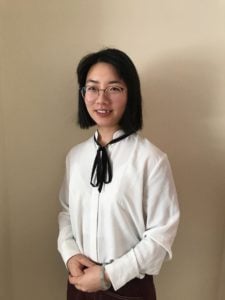
How did you become a therapist and what area of therapy do you specialise in?
I am a bilingual (English/Mandarin) BACP accredited psychotherapist with a background in Psychology in China. My passion for psychotherapy rather than medication began after I graduated from university and was placed in a hospital. After this, I achieved a Master’s degree in Person-Centred Experiential Counselling and Psychotherapy Practice from the University of Nottingham.
My role is based on counselling adults and I value the potential of every human being to change and learn throughout their lives. I aim to provide an empathic and judgment-free environment where our users feel safe and accepted.
What type of support/therapy do you give to our users via Thrive?
Person-Centred Therapy is my approach. It is based on the belief that each of us is capable of self-healing and personal growth. The goal of this type of therapy is to create an environment of compassion and empathy where difficult feelings can be explored safely. It can help users to identify and utilise their own strengths, and to reconnect with their inner values and sense of self-worth.
Why is digital therapy the most effective form of support? What are some of the benefits of the digital aspect versus in-person therapy?
Online and telephone therapy sessions are a great way to get therapeutic support from the comfort of your own home. This means you can fit them around work and other commitments. Our therapists are experienced in delivering sessions remotely and can help you to create a safe and therapeutic space within your own home.
What is your favourite thing about working at Thrive and being part of the therapy team?
Trust. Our supervisors are very supportive and they trust all of our therapists in many ways.
Harmony. There’s no conflict among colleagues as everyone is nice and supportive.
Ana Sousa Psychological Therapist
How did you become a therapist and what area of therapy do you specialise in?
I am bilingual in English and Portuguese and I have a Master’s Degree in Clinical Psychology and a Postgraduate in Clinical Sexology. For a year as a Junior Psychologist, I helped a team of psychologists to develop social, communication, motor and educational skills in children with special needs. I have taught diverse groups of children with autism, learning disabilities and non-compliant behaviour.
After that, I worked as a Clinical Psychologist for a Football Club. Here I applied cognitive-behavioural therapy to children, teenagers and young adults to help them with learning difficulties, anxiety, depression and behavioural problems.
What type of support/therapy do you give to our users via Thrive?
I offer remote counselling sessions via messaging. Extra support includes live sessions of Calm Breathing and Deep Muscle Relaxation for Portuguese clients. Additionally, I host presentations to guide users through using the Thrive: Mental Wellbeing app.
Why is digital therapy the most effective form of support? What are some of the benefits of the digital aspect versus in-person therapy?
Distance is no longer a barrier, and there is someone ready to help you at the click of a button. Therefore, you can connect with a therapist whenever and wherever suits you.
What is your favourite thing about working at Thrive and being part of the therapy team?
Everyone at Thrive is respectful, friendly, and incredibly helpful. We have a great culture where open communication is encouraged. Thrive gives me great autonomy which makes me more engaged and motivated.
Nosa Eboreime Psychological TherapisT

How did you become a therapist and what area of therapy do you specialise in?
After completing my undergraduate degree in Psychology, I took a 5-year break from studying to build my experience in mental health. Working as a mental healthcare assistant in numerous private hospitals then allowed me to work on different wards. I also worked at Broadmoor hospital and other forensic mental health units.
After this I embarked on a Master’s degree in Cognitive Behavioural Therapy (CBT) and have worked as a Psychological Therapist at Thrive for 6 months now.
What type of support/therapy do you give to our users via Thrive?
- I offer CBT-based therapy support to users via messaging, video or voice calls.
- Guided support sessions on how to use the App and its CBT content independently.
- I support signposting referrals for users.
Why is digital therapy the most effective form of support? What are some of the benefits of the digital aspect versus in-person therapy?
Its accessibility is a key advantage as people can access support from their homes or during their lunch at work. Online therapy also has a higher attendance rate for sessions compared to in-person therapy.
What is your favourite thing about working at Thrive and being part of the therapy team?
Community. A cohesive group of therapists who are happy to help, and are motivated to improve the quality of support for our users and other staff at Thrive.
Company ethos. Thrive’s ethos is shared across all parts of the organisation, from the developers and relationship managers to the therapists and other departments.